
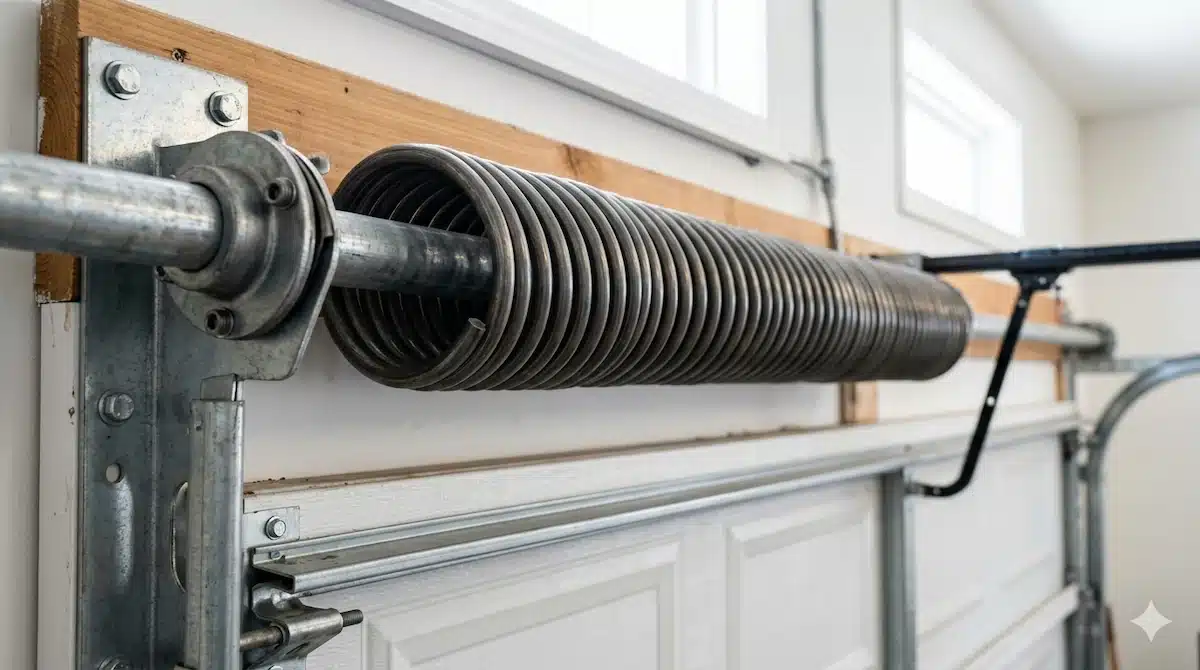
If a technician has ever mentioned your garage door springs, you may have heard the words “torsion” or “extension” without a clear picture of what they actually mean or why it matters.
The type of spring your door uses affects how it operates, how long the springs last, what happens when one fails, and what replacing them costs.
Why Garage Doors Need Springs
Garage doors are heavier than most people realize. The springs do most of the actual lifting. The opener’s job is mainly to move the door smoothly and control its travel.
Springs store mechanical energy when the door closes and release it when the door opens, counterbalancing the door’s weight so the opener only has to manage a fraction of the load. When a spring fails, the opener suddenly has to handle the full weight of the door, which is why a broken spring usually means the door won’t open at all, or opens only partially before the opener strains and stops.
Torsion Springs
Torsion springs are mounted horizontally on a metal shaft above the garage door opening. You’ll see them as one or two coiled springs running across the top of the door when it’s closed.
They work by twisting. As the door closes, the spring winds tighter, storing energy in the twist. When the door opens, the spring unwinds and transfers that energy through the shaft and cable drums to lift the door.
Why torsion springs are the standard choice
Most garage doors installed in Ottawa in the last 20 years use torsion springs, and for good reason:
Longer lifespan: Torsion springs are rated for 15,000–20,000 cycles under normal conditions. Under normal household use, that often translates to a decade or more before replacement is needed.
Smoother, more controlled movement: Because the force is applied through a central shaft, torsion springs lift the door more evenly. You’ll notice less jerking or shaking during operation.
Better durability in harsh climates: Because torsion systems are more enclosed and distribute force differently, they generally hold up well in places with significant seasonal temperature swings like Ottawa.
Safer when they break: A torsion spring that snaps stays on the shaft. It doesn’t go anywhere. An extension spring failure is a different story.
More compact: Torsion springs require only the space above the door opening, making them suitable for garages with lower ceilings or less headroom along the side tracks.
Extension Springs
Extension springs run along the horizontal tracks on either side of the door, specifically the parts of the track that run parallel to the ceiling when the door is open. They’re long, coiled springs that stretch when the door is closed and contract as it opens, storing energy through elongation rather than torsion.
When extension springs are used
Extension springs are less common in newer installations but still found in many Ottawa homes, particularly:
- Older homes built before torsion spring systems became standard
- Garages with very low ceilings where there isn’t enough headroom above the door for a torsion spring
- Lighter doors where the simpler extension spring setup is sufficient
A note on extension spring safety
Extension springs have a shorter service life, typically 8,000–10,000 cycles compared to 15,000–20,000 for torsion springs. In practice, many homeowners replace extension springs sooner than torsion springs simply because they wear out faster.
They’re also more exposed. Extension springs run along the open track rather than on a contained shaft, which means they’re more susceptible to rust, debris, and the kind of mechanical stress Ottawa’s winters create.
When one breaks, the difference from torsion springs becomes clear. An extension spring under full tension that snaps can release energy violently, and without a proper safety cable running through the center of the spring to contain it, a broken spring becomes a projectile. Safety cables are standard on modern installations and should be present on any extension spring system, but older setups may not have them.
How Ottawa’s Climate Affects Both Types
Garage door springs in Ottawa tend to wear faster than those in milder climates.
Cold makes metal contract. In very cold weather, springs are under more stress at rest than they would be at moderate temperatures. This is one reason springs often break in winter: they’re already under greater tension before a single door cycle.
Years of freezing and thawing gradually add wear that standard cycle ratings don’t always account for. A spring rated for 15,000 cycles in a climate-controlled environment may not reach that number in an Ottawa garage.
Uninsulated garages amplify the effect. The more extreme the temperature swings inside the garage, the harder the springs work. An insulated door and a weather sealed garage meaningfully extend spring life.

How to Tell Which Type You Have
The easiest way: stand inside your garage and look up.
- Springs above the door, running horizontally on a bar? Torsion springs.
- Springs along the side tracks, running toward the back of the garage? Extension springs.
If you’re not sure, a photo taken inside your garage is usually enough for us to identify the system immediately.
Does It Matter When Something Goes Wrong?
Replacement cost differs. Torsion spring replacement typically costs more than extension spring replacement because the components are more substantial and the installation requires more precision. However, because torsion springs last longer, the cost per year of service life often works out similarly or in favour of torsion springs.
One broken spring vs. two. Most torsion spring setups use two springs on a single shaft. When one breaks, most technicians recommend replacing both, because if one has worn out, the other is likely near the end of its life too, and doing both at once saves a second service call. Extension spring setups also typically use two springs (one per side), and the same logic applies.
Upgrading is an option. If your door currently has extension springs and you’re replacing them anyway, it’s worth asking whether a conversion to torsion springs makes sense. It isn’t always the right move, depending on your door weight, ceiling height, and budget, but in many cases the longer lifespan and improved performance are worth the additional upfront cost.
When Should Springs Be Replaced?
Springs should be inspected any time you notice:
- The door feels significantly heavier than usual when lifted manually
- The door opens unevenly, one side higher than the other
- A loud bang from the garage (a breaking spring sounds like a gunshot)
- Visible gaps in the spring coils
- The opener is straining or stopping before the door fully opens
Springs under tension are dangerous to work on without proper training and tools. This is one of those repairs where the risk of a DIY attempt is genuinely high. A spring under load stores a significant amount of energy, and releasing it incorrectly causes serious injury. It’s not a job to attempt without professional equipment. For a broader look at what to watch for, see our guide on quick checks for garage door springs.
Time to Get Your Springs Inspected
Torsion and extension springs do the same job, but they do it differently, and those differences matter for how your door performs, how long the springs last, and what happens when they eventually wear out.
If you’re not sure which type your door has, or if you’re noticing any of the symptoms above, it’s worth having your springs inspected before they fail. A spring that breaks while you’re trying to leave for work at 7am in January is considerably more disruptive than one that gets replaced during a scheduled visit.
If you’d like a technician to take a look, Capital Garage Door Ottawa handles torsion and extension spring repair and replacement throughout Ottawa and the surrounding area. Request a free estimate online or call (613) 604-9779.
Frequently Asked Questions
Can I tell which type of spring I have without a technician?
Yes. Stand inside your garage and look up. If you see a coiled spring mounted horizontally above the door on a metal shaft, that’s a torsion spring. If you see long springs running alongside the horizontal tracks toward the back of the garage, those are extension springs. A photo sent to a technician can confirm it if you’re still not sure.
Is one type better than the other?
Torsion springs generally outperform extension springs in longevity, smoothness, and safety, which is why they’ve become the standard on most residential doors. That said, extension springs are still a reliable option for the right door and garage configuration. The best choice depends on your specific setup.
My spring broke. Do I need to replace both?
In most cases, yes. If one spring has worn out, the other is typically close behind. Replacing both at the same time avoids a second service call in the near future and ensures the door is balanced properly.
Can I upgrade from extension springs to torsion springs?
Often yes, though it depends on your ceiling height and door weight. It’s a common upgrade and worthwhile if you’re already replacing extension springs that are nearing the end of their life. A technician can assess whether your garage is a good candidate.
Why do springs break more often in winter?
Cold temperatures cause metal to contract, which puts springs under greater stress at rest. Combined with Ottawa’s freeze-thaw cycles, springs in uninsulated garages are under more strain than the cycle ratings alone would suggest. A loud bang from the garage on a cold morning is often the first sign.